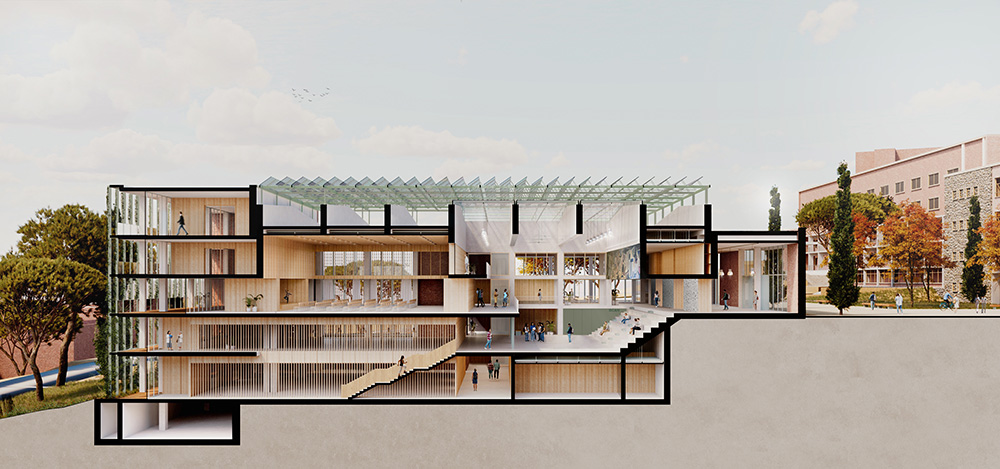
© Scob arquitectura i paisatge & Barceló Balanzó arquitectes
The Government of Catalonia has confirmed the allocation of €5,900,558.28 from the European Regional Development Fund (ERDF), which will make it possible to move forward with the Barcelona Center for Applied Neurosciences (BCAN) at the Old Theatre building on the University of Barcelona’s Mundet Campus.
The BCAN will become an international benchmark and a driving force for research and innovation in neuroscience and health-oriented neurotechnologies. It is a multidisciplinary, cross-sector project that will bring together actors from the fields of research and innovation, healthcare, technology and industry. The UB is leading the project through the Institute of Neurosciences (UBneuro), with the institutional support of the Government of Catalonia and the Barcelona Provincial Council, in a project that is open to other public universities in Barcelona working in this field. The project has a budget of €11,801,116.55, funded in equal parts by the Barcelona Provincial Council and the ERDF.
The BCAN marks the starting point of a “new era for neuroscience“. This is how Jordi Alberch, director of the Institute of Neurosciences, sees it. He has been involved in the project since it began three years ago, when it was first presented, and they started working together with the Barcelona Provincial Council and the Government of Catalonia. “It is a once-in-a-generation opportunity for the country to make an unprecedented scientific leap in the field of mental health, the development of technical equipment and knowledge.” There is currently no centre in Spain with the characteristics of the BCAN, which will be one of the few institutes in Europe dedicated to neuroscience in its full scope: cognitive neuroscience, neuroimaging, neurostimulation, virtual reality, genetic bases, biomarkers, applied artificial intelligence, and more.
The rising incidence of neurological and mental disorders makes research in neuroscience a priority. It is estimated that 10 million people in Europe live with dementia, and this figure is expected to double by 2050, while around 40 million people experience clinical depression. The creation of the BCAN is an excellent opportunity to position Catalonia as an international benchmark in the development and innovation of applied neuroscience.
The long trajectory of the project has enabled progress in several areas, such as the acquisition of materials and equipment, and an initial round of hiring that has led to the creation of the Cognitive Neuroscience Unit. In this way, once the building works are completed, it will not be necessary to start the process from scratch; the BCAN will already be up and running and will act as a magnet for talent and for investment from major companies.
A project that combines scientific innovation and artistic heritage
The BCAN will be housed in the Mundet Campus’ Old Theatre building, under the guidance of Barceló Balanzó Arquitectes and Scob Arquitectura i Paisatge. Their proposal, selected through a public competition in June, acknowledges the uniqueness of Josep Maria Baldrich’s building and preserves its memory, while transforming it into a first-class research centre.

The project preserves the building’s distinctive features, such as the theatre’s seating, and it integrates them into the new spatial organization. It also highlights the murals that form part of the theatre’s artistic legacy: the works by Josep Guinovart, Julio Bono, and Armand Olivé are not only preserved but gain prominence thanks to an architectural proposal that positions them as a unifying thread. Barceló Balanzó and Scob envision a building where these pieces cease to be mere decorative elements and become defining features of the BCAN’s identity. The result will be a space where artistic and heritage memory coexists harmoniously with scientific and technological innovation.
Regarding the spaces, the architectural project plans to maintain the meeting areas, the lobby, and the multipurpose atrium at the entrance level, while the laboratories and advanced research areas will occupy the more private zones. The building will also include a neuroincubator with technological validation spaces and areas for community integration, the Administration of the Center at Mundet Campus, and teaching areas. Altogether, this will ensure that the space aligns with the objectives of the BCAN, a project that unites research, innovation, and education. The proposal incorporates a series of bioclimatic and energy strategies, such as active façades, a green roof with photovoltaic panels, comprehensive water management, and the use of low-impact materials, forming a sustainable and adaptable architectural model. All of this takes advantage of the existing structure and employs dry industrialized construction systems, reducing construction time, waste, and costs.
Construction works are scheduled to begin in July 2027 and to be completed by December 2028.


